
Customizing AI Responses
Every setting that changes how the AI assistant answers you lives in one place: Customize Responses. This is the full reference for what each one does.
Opening Customize Responses
Section titled “Opening Customize Responses”- Open a chat page.
- Click the gear icon in the top navigation bar. The Customize Responses panel opens.
- Change what you want, then click Apply to save.
Cancel discards your edits. Reset to Defaults puts every setting back, after a confirmation.
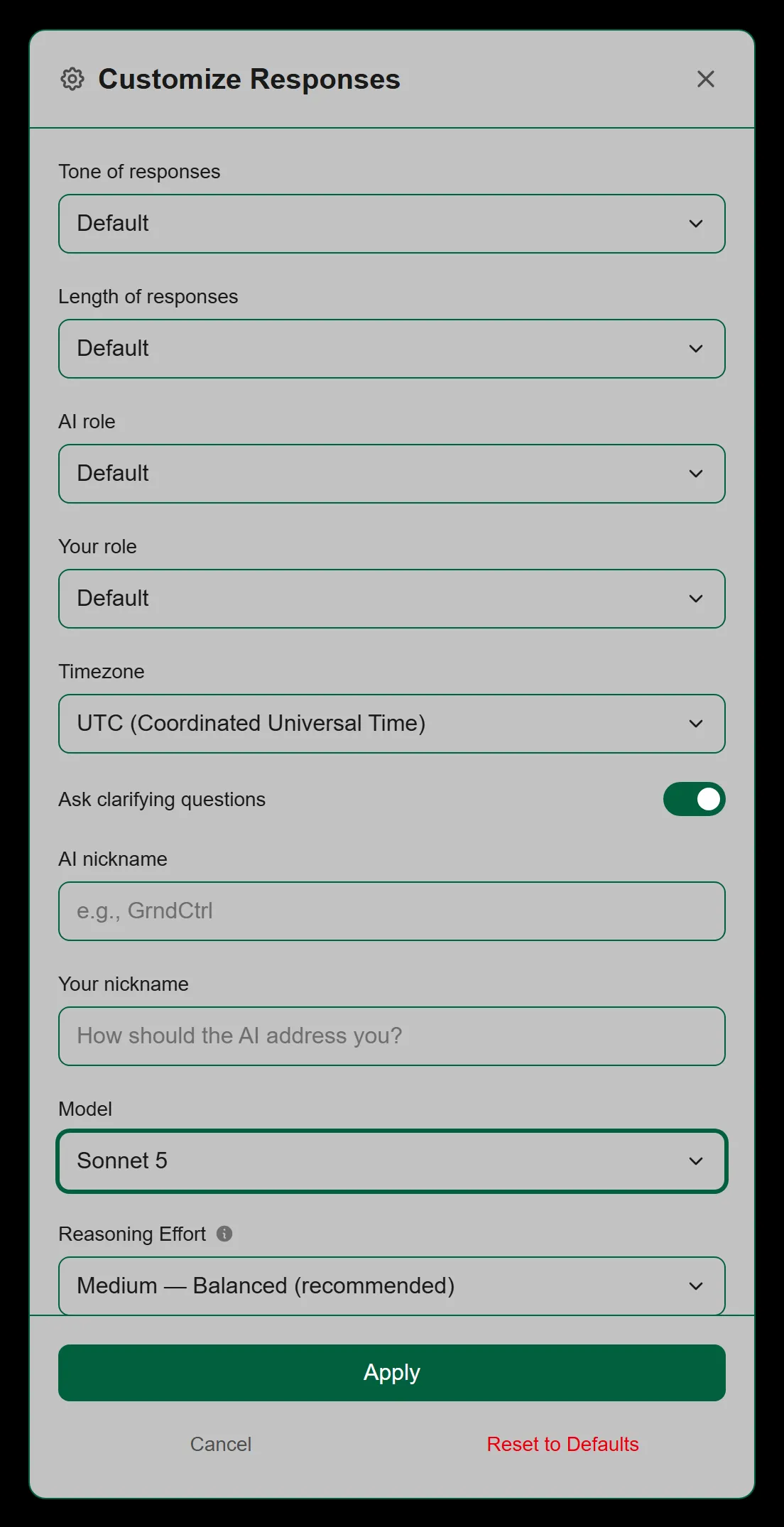
The Settings
Section titled “The Settings”| Setting | Options | What it does |
|---|---|---|
| Model | Default (Sonnet 5), Sonnet 5, Opus 4.8 | Which model answers you. Default suits almost everyone; Opus is slower but stronger on hard analysis. |
| Reasoning Effort | Low — Faster, less thorough Medium — Balanced (recommended) High — Slower, more thorough | How much the model “thinks” before responding. Low is good for simple questions; High is better for complex analysis. This control only appears on Sonnet — switch to Opus and it disappears. |
| Tone of responses | Default, Professional, Friendly, Concise | How the assistant communicates. |
| Length of responses | Default, Short, Detailed | How much detail each answer carries. |
| AI role | Default, Subject Matter Expert, Teacher, Quick Assistant | The persona it adopts. Teacher explains step by step; Quick Assistant gets to the point. |
| Your role | Default, Engineer, Developer, Architect, Project Manager, Executive, Director, Field Inspector, Technician, Coordinator, Administration | Tells the assistant what you do, so it pitches answers at the right level. This is separate from AI role and from your nickname. |
| AI nickname | Free text, up to 50 characters | What you want to call the assistant. |
| Your nickname | Free text, up to 50 characters | What the assistant calls you. |
| Ask clarifying questions | On / Off | When on, the assistant asks a follow-up instead of guessing at an ambiguous question. On by default. |
| Additional instructions | Free text, up to 1,000 characters | A standing instruction applied to every conversation — for example, “Always cite specific code sections when referencing documents.” A running character count sits under the box. |
| Timezone | UTC, Eastern, Central, Mountain, Arizona, Pacific, Alaska, Hawaii | Used for dates and times in answers. This is a fixed list of seven United States zones plus UTC — if you work outside them, pick UTC and convert. |
Where to Start
Section titled “Where to Start”If you are unsure, leave everything on Default — the defaults suit most people, and you can adjust as you get a feel for the assistant. The two settings that change the most for the least effort are Length of responses and Your role.
Troubleshooting
Section titled “Troubleshooting”There is no gear icon
Section titled “There is no gear icon”Solutions:
- The gear is on the chat page header, not on the Home screen. Open a chat first.
- On a narrow screen the header controls collapse into the right-hand cluster. Widen the window if you cannot see it.
Reasoning Effort has disappeared
Section titled “Reasoning Effort has disappeared”Solutions:
- Your Model is set to Opus 4.8. The control only applies to Sonnet models.
- Switch back to Default (Sonnet 5) or Sonnet 5 and your saved value returns.
I changed a setting but answers look the same
Section titled “I changed a setting but answers look the same”Solutions:
- Check you clicked Apply. Cancel discards everything you changed.
- These settings shape how the assistant writes, not what it knows. If an answer is missing information, the document library is the place to look — see Documents and AI Chat.
- Ask a fresh question. A setting change does not rewrite answers already on screen.
Related Articles
Section titled “Related Articles”- AI Chat Tools and Smart Search — What the assistant can do, and how its tools work
- Documents and AI Chat — Asking questions of your company’s documents
- Getting Started with GrndCtrl — Signing in and finding your way around
- Prompt Management — The organization-wide policies an administrator sets (administrators)