
What Happens in Salesforce and NetSuite When a Quote Is Won or Lost
When a quote is marked Won or Lost, GrndCtrl can tell Salesforce and NetSuite about it without anyone re-typing the deal. This article is for the estimator who wants to know what was sent, and for the administrator who has to turn it on and keep it configured.
The Whole Thing in One Picture
Section titled “The Whole Thing in One Picture”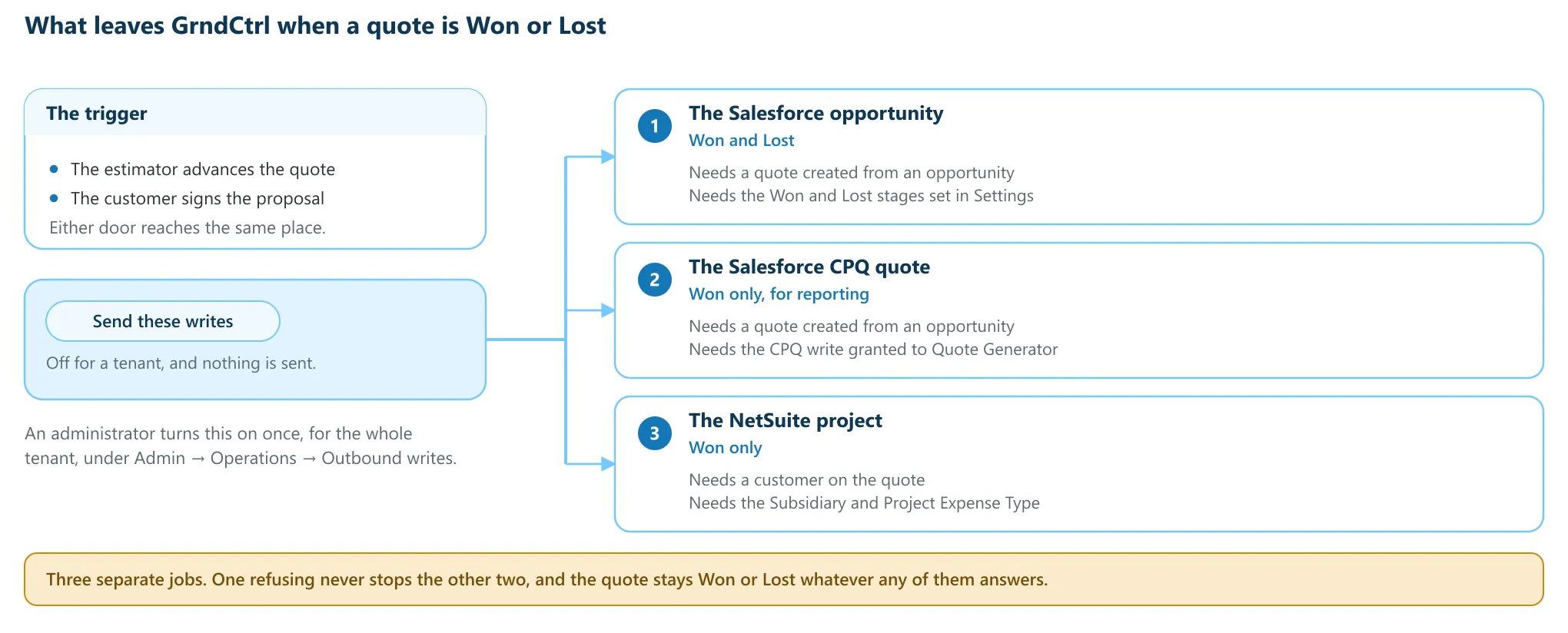
Three writes leave GrndCtrl, and each one is its own job with its own requirements:
- The Salesforce opportunity — on Won and on Lost.
- The Salesforce CPQ quote — on Won only, for reporting.
- The NetSuite project — on Won only.
When They Run
Section titled “When They Run”Two doors reach the same place. An estimator picks the stage from Advance to… on the quote, or the customer accepts the proposal and the quote reaches Won on its own. Either way the three jobs are queued at that moment and run separately.
Nothing any of them answers changes the quote. A refusal in Salesforce or NetSuite leaves the quote exactly as decided, and the reason is kept on the quote for someone to act on.
Marking a Quote Lost
Section titled “Marking a Quote Lost”With the writes on, picking Lost opens Mark this quote Lost first: “Optionally pick why — it is written to the linked Salesforce opportunity alongside the stage. Leave it blank and GrndCtrl uses the tenant’s default, or nothing at all.” The Loss reason list is read live from Salesforce, so it offers your own values and nothing else.
- Pick a reason, then Mark Lost.
- Leave it on “No reason — leave it to GrndCtrl’s default” and your tenant’s default is used, or nothing at all if there is no default.
- Cancel leaves the quote where it was.
The dialog appears only where the writes are on. With them off, picking Lost behaves as it always has.
The Salesforce Close-Out
Section titled “The Salesforce Close-Out”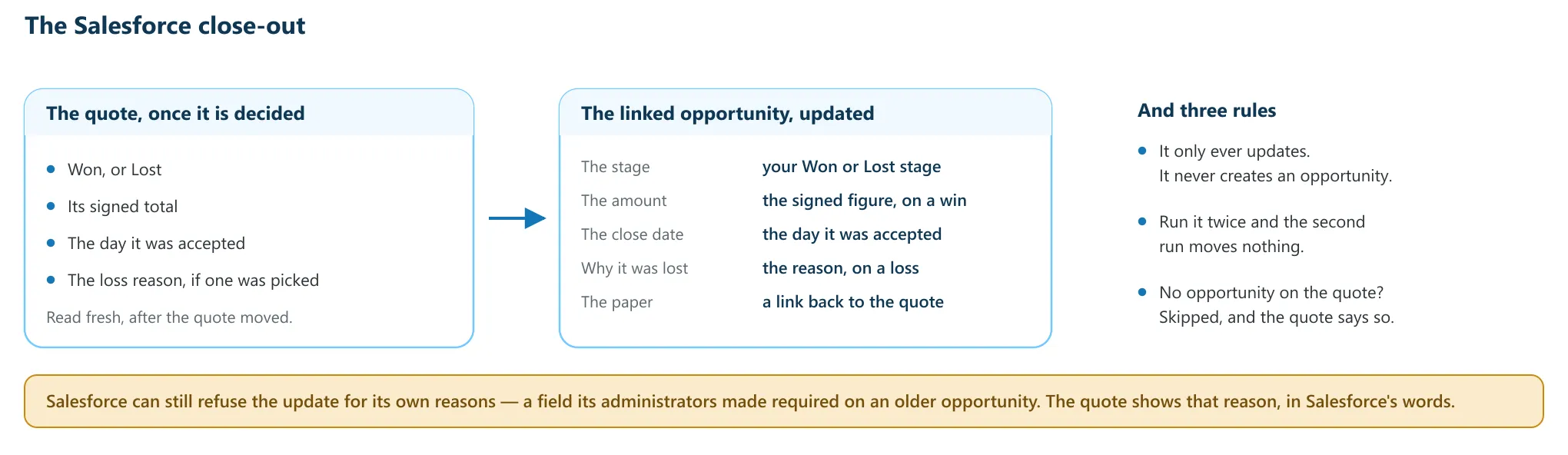
This is the write the rest of your Salesforce depends on: pipeline, forecast, capture rate, and the opportunity a rep opens. It updates the opportunity the quote was created from with the stage, the amount on a win, the close date, the loss reason on a loss, and a link back to the quote.
The stage is yours, not ours — it is whichever value your administrator picked from Salesforce’s own list for Won stage and Lost stage. The amount is the figure the customer signed for; where a quote was won by hand, it is the quote’s own total. The loss reason is the one picked on the Lost dialog, then your tenant’s default, then nothing at all — an empty reason is left alone rather than overwritten.
On the quote you get one of three banners. “Salesforce updated — {the stage}” when it landed. “Salesforce close-out failed” with Salesforce’s own message beneath it — including a refusal for reasons that have nothing to do with this quote, such as a field your administrators made required that an older opportunity never filled in. Or the skip, “Salesforce close-out”, with the sentence that says why: “this quote was not created from a Salesforce opportunity, so there is nothing to close out”, or “Salesforce close-out is not configured — set the {Won or Lost} stage in Settings” with an Open Settings link beside it.
Under the hood: the write is an update addressed by the opportunity’s own id — it never creates an opportunity, and a second run sends nothing because the values already match.
The CPQ Quote
Section titled “The CPQ Quote”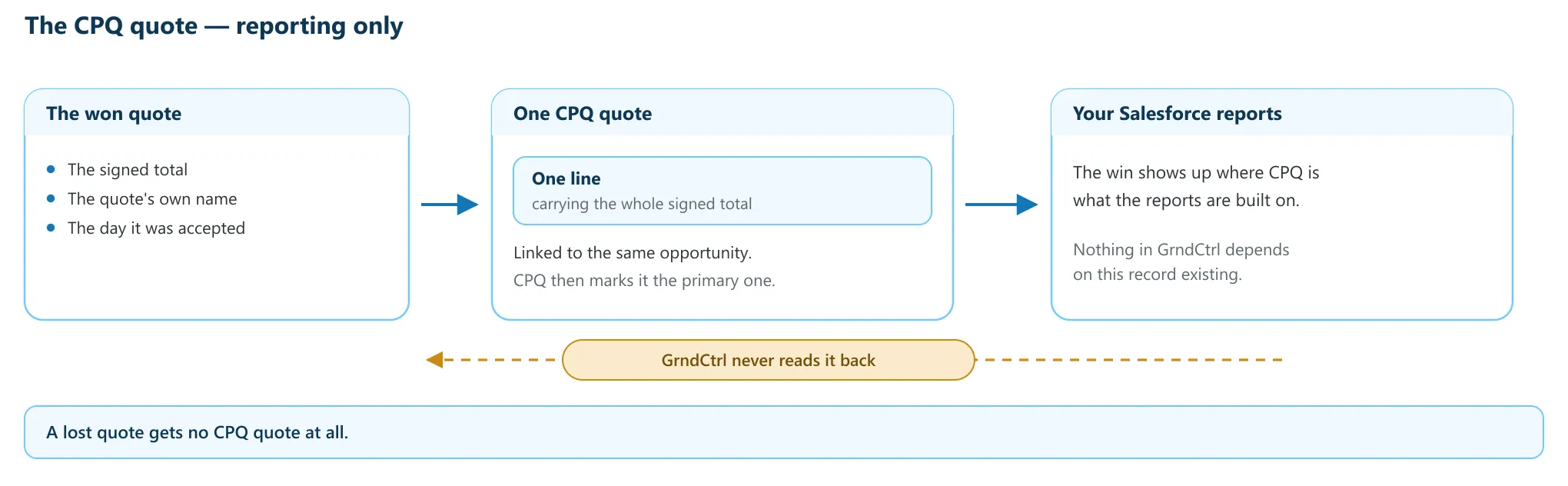
A won quote also records itself in Salesforce CPQ, and that record exists for one reason: reports built on CPQ objects keep working now that quotes are written in GrndCtrl. It is one CPQ quote carrying one line at the signed total, linked to the same opportunity, which CPQ itself then marks as that opportunity’s primary quote.
GrndCtrl never reads the record back — not the price, not the line, not to check that it arrived. A lost quote gets no CPQ quote at all.
The banner names it: “CPQ quote created” followed by the new record’s id, or “CPQ quote failed — reporting only”. The failure always says what the opportunity close-out itself did, rather than assuming — for example “The opportunity close-out is unaffected —” then “the opportunity close-out succeeded” with the stage it wrote.
Under the hood: the CPQ write is verified by its own answer and recorded on the quote at the moment it happens, because nothing is ever allowed to read it back.
The NetSuite Project
Section titled “The NetSuite Project”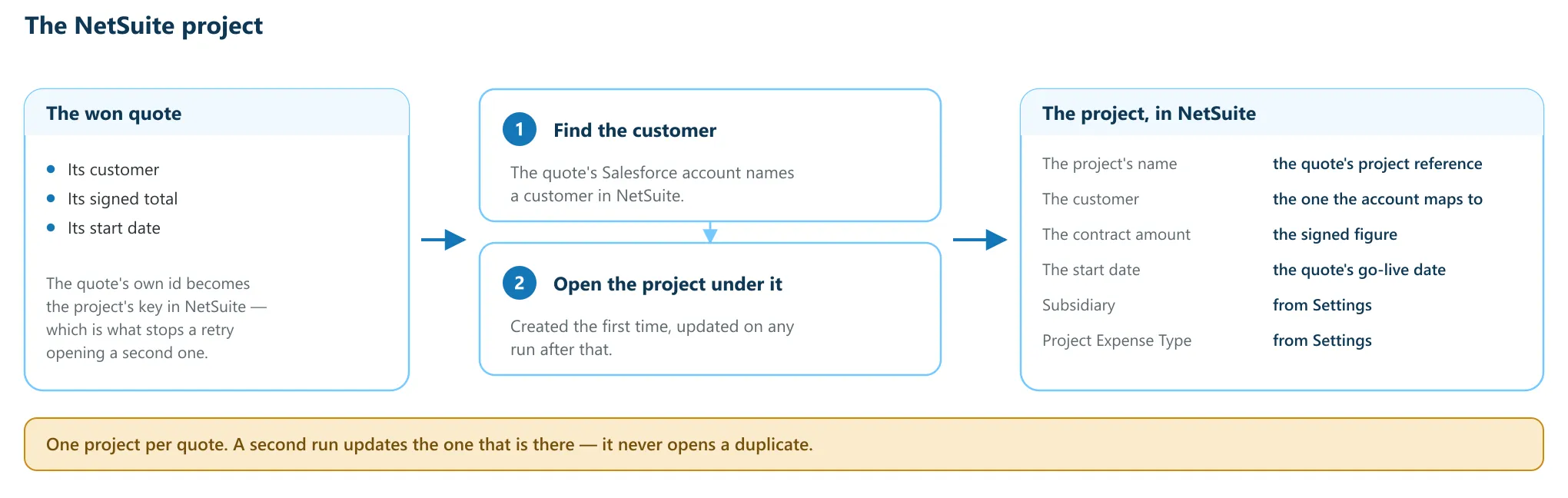
On a win, GrndCtrl opens a NetSuite project for the work. It first finds the NetSuite customer that the quote’s Salesforce account maps to, then creates the project under that customer, carrying the project name, the contract amount and the start date.
Two values NetSuite requires on every project cannot come from a quote, so an administrator sets them once: Subsidiary (NetSuite internal id) and Project Expense Type (NetSuite internal id). The project is keyed by the quote, so running the write again updates the project that is already there instead of opening a second one.
The banner reads “NetSuite project created” with the project’s id, or “already up to date” when the write found nothing to change, or “NetSuite project failed” with NetSuite’s own message. The skips name what is missing: “this quote has no customer, so there is nobody to open a NetSuite project under”, “the NetSuite project defaults are not configured — set the Subsidiary and Project Expense Type in Settings”, “this customer is not visible to the NetSuite connection, so the project has nobody to hang on”, or “the NetSuite connection returned this customer without an internal id, so the project’s customer link cannot be built”.
Under the hood: a customer the connection does not return is reported as not visible, never as deleted — a connection can only say what it was shown.
What the Quote Shows
Section titled “What the Quote Shows”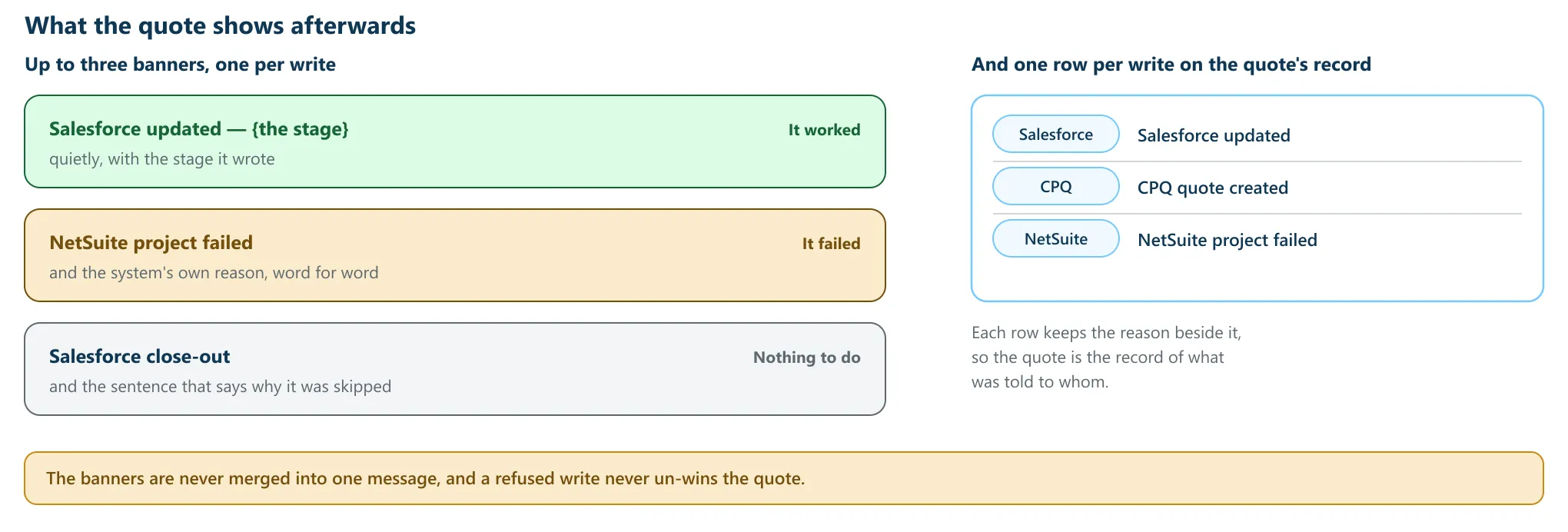
Each write gets its own banner, and they are never merged into one message: a CPQ failure is a reporting gap and a close-out failure is a pipeline one, and a single sentence covering both would hide which is which. A write that landed says so quietly; a write that was refused shows the other system’s own words.
The quote’s record keeps the same three answers as rows, under a Salesforce, CPQ or NetSuite badge — “Salesforce updated”, “Salesforce refused the update”, “Salesforce close-out skipped”, “CPQ quote created”, “CPQ quote failed”, “CPQ quote skipped”, “NetSuite project created”, “NetSuite project failed” and “NetSuite project skipped” — each with the reason beside it. There is no retry button and no re-send: the record keeps the reason, and an administrator resolves it in Salesforce, in NetSuite, or in Settings.
If nothing could be queued at all you get one more banner, “The outbound writes could not be queued”, which says plainly that “the transition stands, but nothing was sent”. The quote is never un-won.
Under the hood: every attempt writes its own row when it happens, so the quote answers what was told to whom without anyone going and looking in the other system.
Turning the Writes On
Section titled “Turning the Writes On”Open Admin → Operations → Outbound writes. The page describes itself: “What GrndCtrl tells Salesforce and NetSuite when an estimator marks a quote Won or Lost.” It has two sections and one switch, and the switch is the last thing you touch.
- Under Salesforce close-out, pick a Won stage and a Lost stage. Both lists hold your own Salesforce values, so there is nothing to type.
- Optionally pick a Default loss reason (optional), used whenever nobody picks one on the Lost dialog. Leaving it on “None — leave it empty when nobody picked one” writes no reason at all.
- Click Save.
- Under NetSuite project, enter Subsidiary (NetSuite internal id) and Project Expense Type (NetSuite internal id), then click Save. These are NetSuite’s own internal ids, and they are yours — never copy them from another company or another environment.
- Turn on Send these writes and click Save. The badge changes from “Off — nothing is sent” to “Sending”.
The switch explains itself before you touch it: “Off — the default — sends nothing: no Salesforce update, no NetSuite project, no CPQ record, for any quote this tenant wins or loses. Turn this on only after the stages above are set and the Salesforce and NetSuite connections have been granted the write.”
Troubleshooting
Section titled “Troubleshooting”The quote is Won but nothing was sent
Section titled “The quote is Won but nothing was sent”There are no banners at all on a quote decided before the writes were turned on, and none on a quote in any stage other than Won or Lost. Check Admin → Operations → Outbound writes: if it reads “Off — nothing is sent”, nothing was queued for this quote and nothing will be.
Salesforce was skipped but the quote looks fine
Section titled “Salesforce was skipped but the quote looks fine”A skip is normal, not an error. The commonest one is “this quote was not created from a Salesforce opportunity, so there is nothing to close out” — a quote started by hand has no opportunity to close, and neither does a clone of one that had. Start the next quote from the opportunity and both Salesforce writes have something to write to.
Salesforce or NetSuite refused the write
Section titled “Salesforce or NetSuite refused the write”The banner carries that system’s own message, and it is the message to act on. A required field left empty on an older opportunity, a customer the connection cannot see, an internal id that is not right for your account: all of them are fixed in that system or in Outbound writes, not on the quote. The quote stays Won or Lost either way.
Only the CPQ write failed
Section titled “Only the CPQ write failed”That is a reporting gap, not a pipeline one, which is why it has its own banner. The banner states what the opportunity close-out actually did, so you can see at a glance whether the deal reached Salesforce. Nothing in GrndCtrl depends on the CPQ record.