
Reading the AI Record
The AI Record is the account of what the product did to your quote and what it decided. Reading it is how an administrator or an estimator answers the only question that matters when a line looks wrong: which hand put it there. This article is a guide to that reading.
The Four Sections
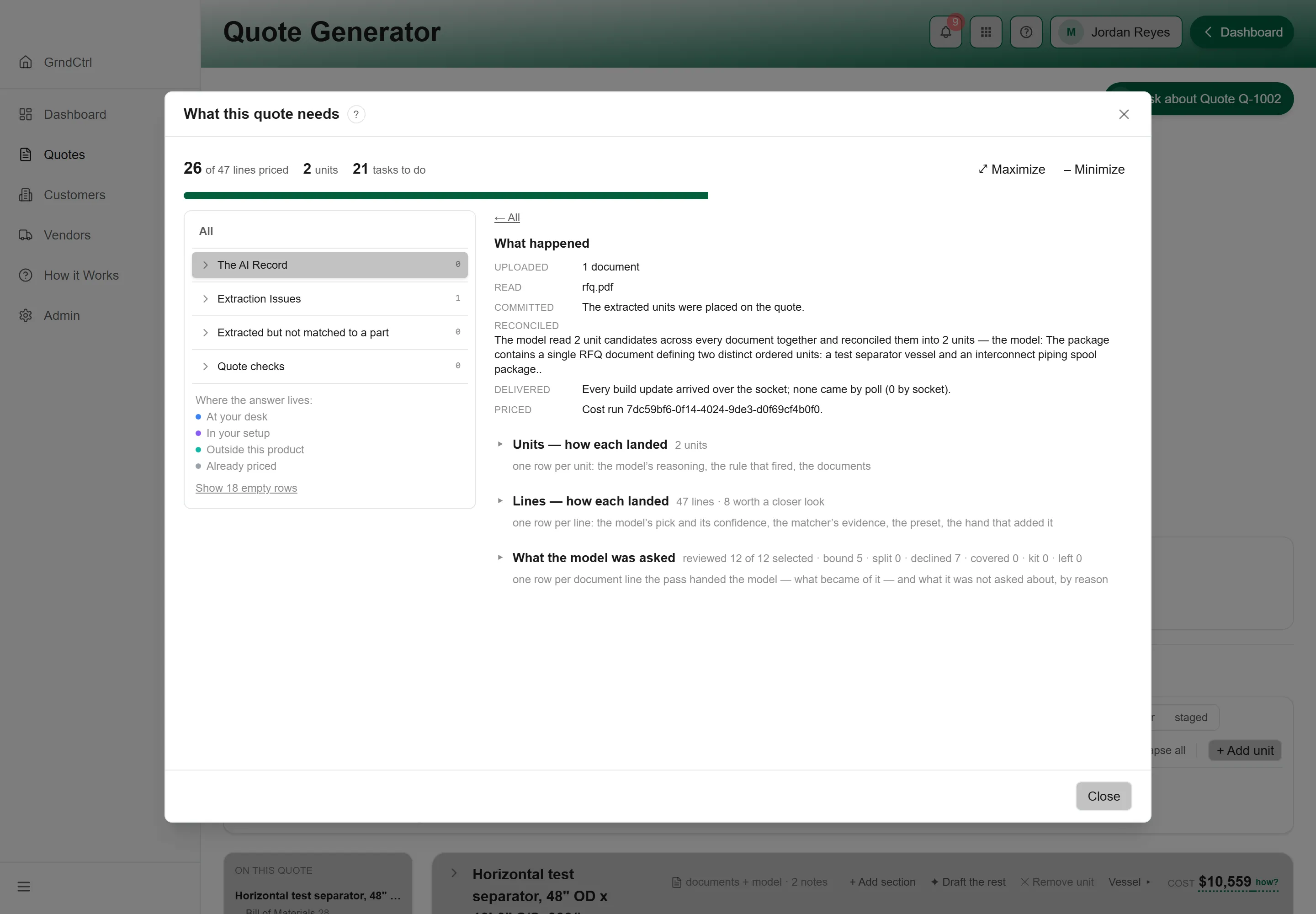
Section titled “The Four Sections”What this quote needs splits into four, and the split is the point: only two of them are work.
| Section | What is in it | Is it a task? |
|---|---|---|
| The AI Record | What the product did and what it decided, including everything it already priced or settled. | No. It is a record. |
| Extraction Issues | A line landed but could not be finished: Multiple Parts Matched, Needs a Price, Could not be finished. | Yes. |
| Extracted but not matched to a part | Read off a document, with no catalog part behind it. | Yes. |
| Quote checks | Standards, approved manufacturers, the price book, vendor rounds. | Sometimes. |
A row that the product already decided sits in the record, not in a task list. That is deliberate. An estimator is giving the whole quote attention anyway, and a list that counts settled work as outstanding is a list nobody trusts.
What One Line Tells You
Section titled “What One Line Tells You”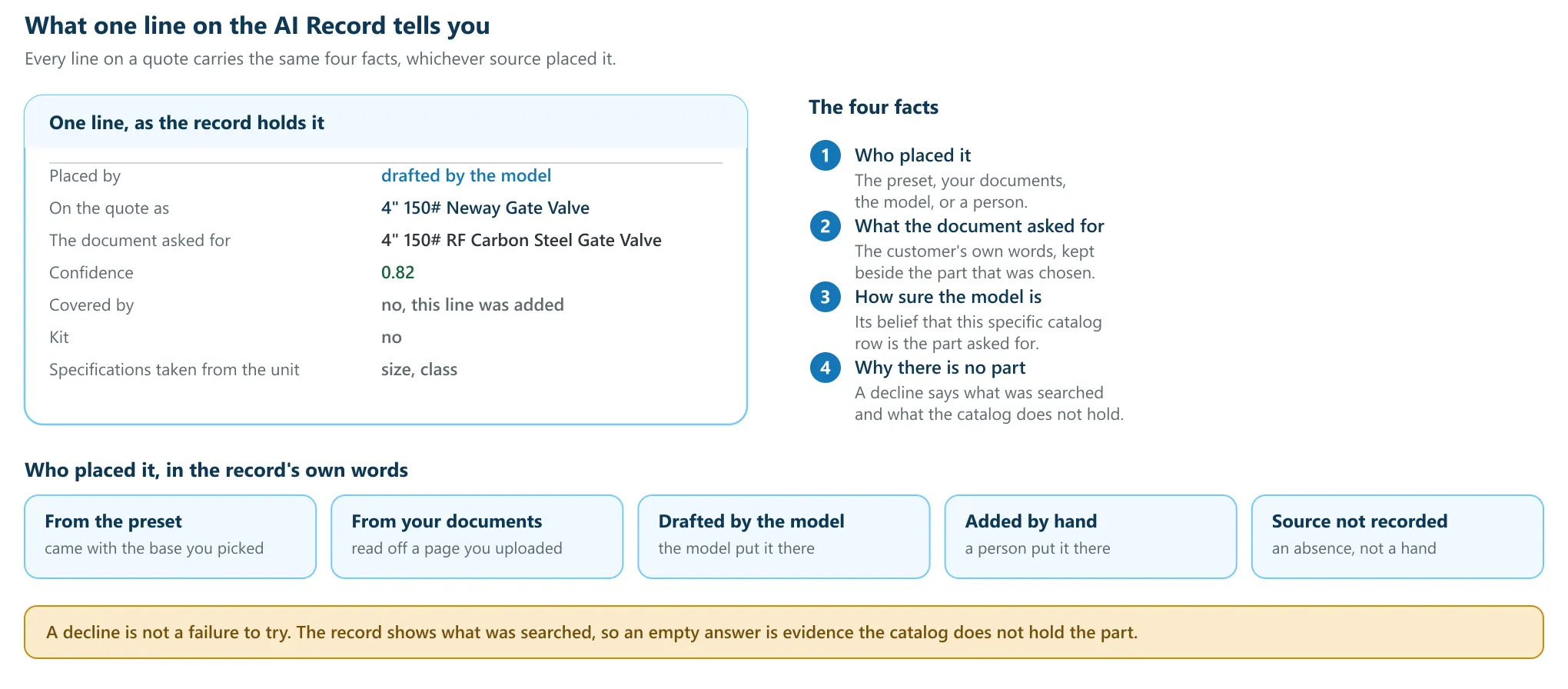
Who placed it
Section titled “Who placed it”Four sources put lines on a quote, and every line belongs to one. These are the words the unit’s own control uses.
- From the preset: it came with the base you picked, or inside a kit that base carries. A base only adds, so nothing here is a guess.
- From your documents: read off a page you uploaded, in the document’s own words.
- Drafted by the model: the model put it there, whether during its pass over the extracted lines or while drafting a unit that arrived with no parts list.
- Added by hand: a person added or changed it. Nothing overwrites this.
A fifth reading, Source not recorded, means the line carries no source at all. It is an absence rather than a fifth hand, and on a current quote it should not appear.
A line the model drafted also records who decided it, so a drafted line and a line a person kept are told apart on the record rather than by memory.
The unit’s own control
Section titled “The unit’s own control”Each unit carries one control that answers three questions at once: where the unit came from, what its lines are made of, and what the intake noted about it. Press it and the notes open.
The composition is counted from the unit’s own lines, so it is a measurement rather than a label: a unit reads “42 lines: 24 from the preset · 18 drafted by the model”, or, where every line has one source, “24 lines from the preset”. A unit that has no lines yet says “this unit has no lines yet” rather than counting to zero.
What the document asked for
Section titled “What the document asked for”A bound line carries both its catalog part and the customer’s own words. When a document asks for a 4-inch 150-pound RF carbon steel gate valve and your catalog holds that valve under a manufacturer the customer never named, the line shows the catalog part and keeps the request beside it. That pairing is what makes a bind checkable at a glance.
Confidence
Section titled “Confidence”Confidence is “the model’s own belief that this specific catalog row is the part the document asked for”. Three things follow from that definition, and each one has caught somebody out.
- It is about one row, not about the line, the unit or the quote.
- “a line it could not bind has no confidence”. A decline carries no number at all, because there is no row to be confident about. A confident-looking decline is a contradiction, not a strong opinion.
- A number under your tenant’s bar marks the line “worth a closer look” and does nothing else. The line is bound, priced and on the quote either way.
Why there is no part
Section titled “Why there is no part”A line the model declined stays on the quote at $0, and “its reasoning says what was missing”. The useful declines are the ones that prove an absence: the reasoning names what was searched, so an empty answer is evidence about your catalog rather than a shrug.
Covered by the base
Section titled “Covered by the base”Where a document line asks for something the base already carries, the model says so rather than adding it twice. The base line stands and the document line records that it is already covered. Where the two disagree about size or quantity, the disagreement is listed for a person to settle instead of being resolved quietly.
Specifications taken from the unit
Section titled “Specifications taken from the unit”A document line often names less than the part needs. Where the line states no size or class, the model takes the unit’s and records that it did, so an inherited value is never mistaken for one the customer wrote down.
Lines With No Unit Yet
Section titled “Lines With No Unit Yet”A document can describe parts without saying which unit they belong to. Where the package makes that plain, the lines land on the unit and ride the normal path like any other document line. Where it does not, they wait under Unassigned until somebody says.
When the document proves it
Section titled “When the document proves it”A reference design that names one requested unit in its own title block is attached to that unit, and its rows become document lines on it. There is no setting for this and nothing to tune: the evidence is the document’s own heading, so the lever is what the customer wrote, not something in your configuration. Getting more of these attached means asking for drawings whose title block names the unit.
When it does not, and the model had a guess
Section titled “When it does not, and the model had a guess”The model often names a unit the evidence cannot prove. That naming is not thrown away and it is not acted on: the rows stay under Unassigned carrying what was read, and the row offers one control, Place {N lines} on {the unit}. One click places the whole document’s rows on that unit.
The placement is recorded as a person’s, and as a person taking the model’s refused candidate, so the record tells it apart from picking the unit off the row’s own menu. That distinction is the point: a human made a call the evidence could not.
The Timeline
Section titled “The Timeline”The record is also a timeline, and each row carries a kind. These are the words it uses.
| Kind | What happened |
|---|---|
| Uploaded | A document arrived. |
| Read | A document was read into units and lines. |
| Not read | The format was not extractable. Nothing tried and failed; the file is kept and viewable. |
| Extracted | Units and lines came off the documents. |
| Match | A unit was matched to a preset. This is arithmetic, not a model decision. |
| Loaded | A matched preset’s parts list landed on the unit. |
| Model | A model pass decided a batch of document lines. |
| Drafted | The model finished drafting one unit’s parts list. |
| Skipped | The drafter declined a unit, and says why. |
| AI Reasoning | The model’s own account of a decision. |
Match and AI Reasoning are deliberately different words. A match is scoring; a reasoning is a judgement. Reading them as two shades of the same thing is the most common way to misread the record.
Standards, and the Documents They Name
Section titled “Standards, and the Documents They Name”One part of the record is not about lines at all. It opens with both numbers it has, because they answer different questions: how many standards the documents name, and in how many places they name them. Twenty standards cited once each and one standard cited twenty times are not the same package.
The block that needs a person is headed Named by a document in this package, and not included in it. That heading is the mechanism: a file the customer sent named something, and that something is not in the package. Nothing defers to anything.
Each row carries the standard’s name, how many citations it has, the document that named it, and the reasoning. Every citation is its own line with the document’s own words, the file and the page, and the file opens. A row with four citations shows four.
The reasoning column names the act rather than describing the row, and each act is tagged with where its answer lives: At your desk, In your setup, Outside this product, or Already priced.
| What the row is | What the reasoning says to do |
|---|---|
| A document names an attachment the package does not include | “ask the customer for the attachment their document refers to.” |
| A document names another document outright | “ask the customer to send it.” |
| A requirement named by subject, with no specification number | “the document names a requirement without a specification number — decide which document it means.” |
| The standards pass did not finish | “nothing to ask anyone — re-extract a document to read them again.” |
The list ends by saying what is deliberately not on it, so a short list reads as complete rather than as truncated: documents your documents point at and the package already contains, and standard designations, which are a library question and never something to ask a customer for.
Reasoning Through a Quote
Section titled “Reasoning Through a Quote”A reading that works, in order:
- Start with the lines that are wrong, not with the ones that are missing. A wrong line names its hand.
- Read that line’s origin. Extraction, base, model, kit, or a person. This alone decides which lever to reach for.
- For a model line, read the confidence and the reasoning together. A low-confidence bind with sound reasoning is a catalog problem; a high-confidence bind on the wrong part is a specification problem.
- For a decline, read what it searched. If it searched properly and found nothing, that is a catalog task, and the quote was right.
- Only then go to Tuning Quote Generator and move one lever.
Troubleshooting
Section titled “Troubleshooting”A card says “Not recorded for this line.”
Section titled “A card says “Not recorded for this line.””That fact was not stamped when the line was written. It is an absence, not a zero, and it usually means the line came from a path that does not carry that fact. The line’s other facts are still good.
The summary says lines were drafted but none were placed
Section titled “The summary says lines were drafted but none were placed”Units and preset lines arrive by the seeding path and do not increment the placed counter. A count of zero beside a drafted count is both true and normal on a preset-driven package.
A decline shows a confidence number
Section titled “A decline shows a confidence number”It should not, and a very old quote may still carry one from before the rule was enforced. Treat the number as meaningless on a decline: the reasoning is the fact.
A row names several documents
Section titled “A row names several documents”That is the normal case, not an error. A unit is usually described by more than one document, and the row lists each one.